
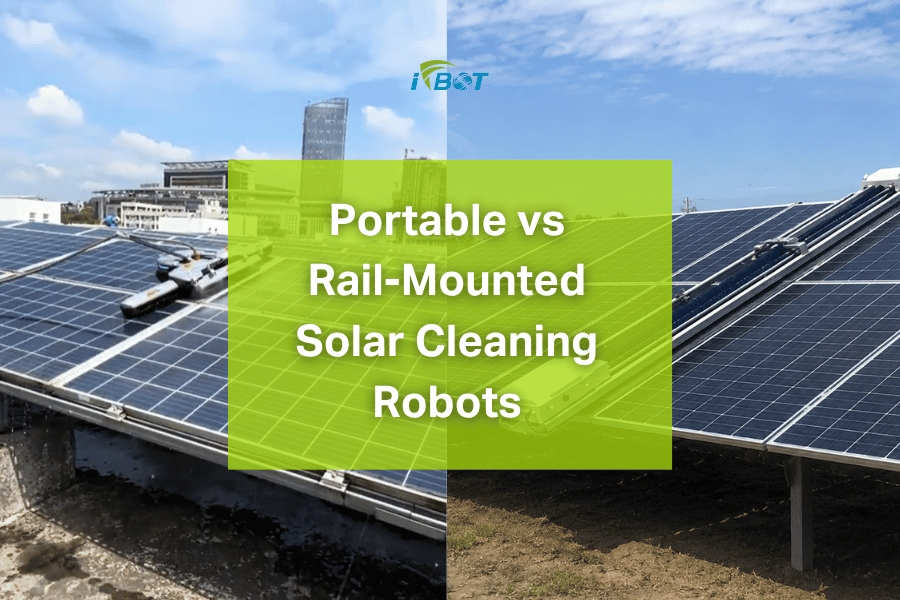
Portable vs Rail-Mounted Solar Cleaning Robots: Which Is Better for Your PV Site?
Choosing between a portable solar panel cleaning robot and a rail-mounted cleaning system is not simply a question of which technology is more advanced. The better system is the one that fits the physical and operational design of the solar plant.
In general:
Portable solar cleaning robots are usually stronger for existing installations, commercial rooftops, fragmented arrays, multiple sites and projects where flexibility matters.
Rail-mounted solar cleaning robots can be stronger for very large, uniform solar plants where cleaning is frequent enough to justify permanent infrastructure and the robots can remain dedicated to specific rows.
Some projects benefit from a hybrid strategy, using permanently installed automation for repetitive sections and portable equipment for exceptions, difficult areas or periodic deep cleaning.
That distinction matters because soiling is not a minor maintenance issue. The IEA Photovoltaic Power Systems Programme identifies soiling as the most influential factor affecting PV system yield after irradiance and estimates average annual global energy losses of approximately 3%–5%. It also stresses that soiling is highly site-specific, which means the cleaning strategy should be site-specific too.
So the real question is not: Portable or rail-mounted - which robot is best?
It is: Which cleaning architecture gives this particular solar site the lowest operational burden while keeping the panels clean often enough?
This guide provides a practical framework for answering that question.
First: portable and autonomous do not mean the same thing
Before comparing systems, an important distinction needs to be made.
Portability describes how the equipment is installed and moved. Autonomy describes how much human control it needs while operating.
A robot can therefore be:
Portable and manually controlled
Portable and semi-automatic
Portable and fully autonomous
Permanently installed and autonomous
Rail-mounted but still require some operator intervention
The IEA PVPS overview of PV cleaning methods makes a similar distinction: portable systems may be moved manually between rows, while fully automatic systems may be rail-mounted, frame-mounted or freely moving.
That is why buyers should avoid treating “rail-mounted” as synonymous with “automatic” or “portable” as synonymous with “manual.”
They are different design choices.
What is a portable solar panel cleaning robot?
A portable solar cleaning robot is brought to the array when cleaning is required rather than being permanently assigned to a particular panel row.
Depending on the model, an operator may:
Carry or transport the robot to the array.
Place it on the modules.
Start or remotely control the cleaning cycle.
Move it to another row or array when required.
Remove and store it after cleaning.
Portable systems can use dry or wet cleaning and can range from relatively simple remote-controlled machines to autonomous robots with edge detection and route planning.
For example, the IFBOT X3 is a 6.2 kg portable autonomous robot using dry brushes and vacuum cleaning. It has 0°–45° applicable tilt range, four-hour battery operation and productivity of 30 m²/h.
The IFBOT M20 takes a different approach. It is a 12.7 kg portable water-powered robot with a 1,300 mm dual-action brush, a productivity of up to 1,000 m²/h and a 0°–15° operating range for wet cleaning.
The important point is that portable does not describe one cleaning technology. It describes an operating model in which the equipment can be deployed where it is needed instead of becoming permanent plant infrastructure.

What is a rail-mounted solar cleaning robot?
A rail-mounted solar cleaning system uses a dedicated physical guide or supporting structure that determines the robot's path along the PV array.
Depending on the design, a project may also include:
Docking stations
Charging infrastructure
Communications equipment
Control software
Weather monitoring
Row-transfer infrastructure
Bridges or shuttle systems
Permanent robots allocated to individual rows or blocks
Commercial systems demonstrate how far this architecture can go. Some railed cleaning solutions include dedicated docking infrastructure, while other large-scale autonomous systems use dedicated bridges or related infrastructure to allow robots to move between sections. This can significantly reduce repetitive deployment work once the system is installed. The trade-off is that the cleaning equipment becomes much more closely integrated with the architecture of the solar plant itself. That difference - portable equipment versus plant infrastructure - is at the heart of the buying decision.
Portable vs rail-mounted solar cleaning robots: quick comparison
| Decision factor | Portable robot | Rail-mounted robot |
|---|---|---|
| Permanent infrastructure | Usually minimal | Usually required |
| Retrofit suitability | High | Depends strongly on existing array design |
| Commercial rooftops | Often well suited | Can be difficult to justify |
| Large uniform solar farms | Suitable with fleet planning | Often a strong application |
| Fragmented arrays | Strong | More complex |
| Moving between sites | Possible | Not practical |
| Routine operator deployment | Usually required | Can be very low |
| High-frequency unattended cleaning | Model-dependent | Major strength |
| Initial site engineering | Usually lower | Usually higher |
| Ability to change cleaning strategy | High | Lower once installed |
| Wet or dry cleaning | Model-dependent | Model-dependent |
| Equipment utilisation across several sites | High | Equipment remains dedicated to one plant |
| Existing PV plants | Often easier to introduce | May require modifications |
| New greenfield projects | Suitable | Can be designed into the plant from the beginning |
Neither column is universally better. The value depends on how often the equipment will clean, how difficult it is to move, and whether permanent infrastructure creates enough operating savings to justify itself.
1. Start with the PV layout - not the robot
The first decision factor should be the physical solar array.
Ask:
Are the rows long and continuous?
Are there gaps between tables?
Are modules at consistent heights?
Is the tilt uniform?
Are there multiple roof sections?
Are there vents, walkways or other obstacles?
Are arrays separated by roads, buildings or terrain?
Is it fixed tilt or a tracker?
Can permanent cleaning infrastructure be installed?
A large solar plant can look ideal for automation based on megawatt capacity but still contain significant row discontinuities. Conversely, a slightly smaller but highly uniform ground-mounted plant may be much easier to automate permanently. This is why MW alone is a poor way to select a cleaning architecture. IFBOT's solar cleaning use cases illustrate how commercial rooftops, trackers and less conventional installations can create very different access and deployment requirements.
Portable systems tend to gain an advantage when:
Rows are fragmented.
Several separate roof sections must be cleaned.
Obstacles prevent one continuous robot route.
Different facilities will share the equipment.
The PV plant already exists.
Permanent tracks would require substantial modification.
Rail-mounted systems tend to gain an advantage when:
Rows are highly repetitive.
The entire plant was designed with automation in mind.
Robots can remain permanently allocated to the arrays.
Cleaning must happen very frequently.
The site is large enough to justify dedicated infrastructure.
2. Is this a new plant or an existing installation?
This is one of the most important - and often overlooked - question.
Greenfield solar projects
When a PV plant is still being designed, rail-mounted automation can be considered together with:
Module arrangement
Tracker design
Structural supports
Electrical infrastructure
Communications
Maintenance access
Robot docking
Row transitions
This creates an opportunity to design the plant around the cleaning system instead of adapting the cleaning system later.
Existing solar plants
Retrofitting is a different problem.
Adding rails or other dedicated infrastructure may require assessment of:
Existing mounting systems
Structural loads
Module clearances
Warranty implications
Row geometry
Installation downtime
Electrical supply
Access
Additional CAPEX
A portable robot can often avoid much of this infrastructure because it arrives as maintenance equipment rather than becoming part of the plant.
For C&I rooftops and existing installations in particular, this can be a major advantage.
3. Cleaning frequency may change the answer
Imagine two identical 50,000 m² solar arrays. One requires cleaning every few days because dust returns rapidly. The other needs cleaning only periodically. Although their physical size is identical, their optimal cleaning architecture may be completely different.
A permanent system becomes easier to justify when the same equipment performs the same repetitive task very frequently.
A portable system becomes more attractive when the equipment would otherwise sit idle for long periods.
The useful metric is therefore not simply: How big is the plant?
It is: How much productive use will we get from the cleaning equipment each year?
This follows the broader economic principle identified by IEA PVPS: cleaning decisions should balance the cost of cleaning against the value of energy otherwise lost to soiling.
4. The hidden factor: transfer burden
Solar cleaning productivity is usually quoted in square metres per hour. But operators rarely spend the entire shift cleaning.
Time can also be consumed by:
Carrying equipment
Moving between rows
Relocating hoses
Changing batteries
Crossing roads
Reaching another rooftop
Transporting robots between blocks
Retrieving equipment
Restarting cleaning cycles
This creates what we call transfer burden.
Transfer burden is the time, labour and equipment required to move a cleaning system from the end of one productive cleaning run to the beginning of the next.
It is one of the most useful ways to compare portable and fixed systems because it exposes costs that nominal cleaning speed does not show.
Rail-mounted systems reduce transfer burden when:
A robot can clean its assigned row automatically and remain there between cycles.
Portable systems reduce infrastructure burden but may increase transfer burden when:
Operators repeatedly move robots between disconnected arrays.
The decision therefore becomes a trade-off: Would it cost more to keep moving the robot—or to build permanent infrastructure so it does not need to move?
That question is more useful than comparing brush speed alone.
5. Calculate effective productivity, not brochure productivity
A robot might have excellent cleaning speed once it begins moving across a panel.
But suppose an eight-hour shift includes:
4.5 hours of cleaning
1 hour of deployment
1 hour of row transfers
30 minutes of battery handling
1 hour of other interruptions
The site's effective productivity is based on the whole eight hours—not the 4.5 hours when the brushes were turning.
For procurement purposes:
Effective site productivity = total area cleaned ÷ total operational time
This is especially important when comparing permanent and portable systems.
A rail-mounted robot may have a lower nominal cleaning rate but lose very little time to deployment.
A portable machine may clean very quickly but require repeated transfers.
Or the opposite may be true on a site where one portable robot can easily move across long continuous arrays.
The only reliable answer comes from the actual layout.
If your O&M team is evaluating cleaning economics, IFBOT's guide to robotic versus manual solar cleaning O&M savings looks more broadly at labour, water, access and cleaning frequency.
6. Portability becomes much more valuable when one robot can serve multiple sites
Consider an O&M contractor responsible for five commercial rooftops.
A permanently installed system must generally be purchased and installed for each compatible project.
A portable robot may be transported between customers.
That changes the economics substantially because the investment is no longer tied to the solar generation of one plant.
One machine may create value at:
Site A on Monday
Site B on Tuesday
Site C later in the week
This concept can be described as asset utilisation.
The more hours a cleaning robot performs useful work each year, the more operating value can potentially be extracted from the investment.
For:
Solar O&M contractors
EPC service teams
Facility groups operating several buildings
Companies with multiple factories
Distributed commercial solar portfolios
portability can therefore be more important than maximum automation.
This is one of the reasons lightweight cleaning robot design matters operationally: moving equipment repeatedly becomes part of the total cleaning cost.
7. Rail-mounted systems become more attractive when the equipment never needs to leave
Now consider the opposite situation.
A large solar farm:
Has thousands of repetitive panel rows.
Experiences heavy recurring dust.
Requires cleaning extremely frequently.
Has limited need for wet deep cleaning.
Will operate for decades.
Can incorporate robotic infrastructure into its design.
Here, portability offers much less value.
The robot does not need to travel to another customer tomorrow. It needs to clean the same arrays repeatedly for years.
Permanent automation can therefore become compelling.
8. Do not confuse robot architecture with cleaning method
Another common purchasing mistake is assuming:
Rail-mounted = dry cleaning
Portable = wet cleaning
Neither is necessarily true.
Cleaning architecture and cleaning mechanism should be evaluated separately.
The site may need:
Dry cleaning for:
Loose dust
Sand
Frequent preventative cleaning
Water-constrained environments
Wet cleaning for:
Bird droppings
Mud
Salt deposits
Industrial residue
Sticky or bonded contamination
The IEA PVPS soiling report treats wet brushes, dry brushes, robots and other technologies as different mitigation options and emphasizes that the soiling environment varies considerably from site to site.
IFBOT takes the same site-specific approach across its portable range. The IFBOT X3 uses dry nano roller brushes combined with vacuum suction, while the IFBOT M20 uses water-assisted dual brushes.
For a deeper comparison, see Dry vs Wet Solar Cleaning Robots.
9. Water logistics can matter more than robot logistics
A wet-cleaning robot is never just a robot.
You must also consider:
Where the water comes from
Water quality
Pumping
Hose length
Hose movement
Storage
Treatment
Drainage
Refill time
At some sites, moving a 12 kg robot is simple while moving hundreds of metres of water supply is the operational bottleneck.
At another site, water infrastructure already exists and the issue is irrelevant.
This is why the cleaning architecture should never be selected independently of the complete workflow.
The M20, for example, offers optional water-supply equipment including a pump, inlet pipe and pipe trolley, while its portable robot itself weighs 12.7 kg.
The robot specification tells only half the story.
10. Labour does not disappear - it changes
Both portable and permanently installed automation can reduce dependence on manual panel cleaning, but they change labour in different ways.
With portable systems, workers may still be needed for:
Transportation
Placement
Row transfer
Battery changes
Water connections
Retrieval
Inspection
The robot performs the repetitive surface-cleaning work.
With rail-mounted systems, workers may instead focus on:
System monitoring
Preventive maintenance
Robot repair
Rail or docking inspection
Communications systems
Exceptional contamination
The difference is important.
A system advertised as “fully automatic” still has maintenance requirements.
The correct labour comparison is therefore not: Human labour versus no human labour.
It is: What type and quantity of human work does each architecture require over a full year?
That produces a more realistic O&M calculation.
11. Think about maintenance concentration
Permanent automation can simplify routine cleaning—but it also creates infrastructure that must remain operational.
Depending on the design, this can include:
Rails
Bridges
Docking stations
Chargers
Communications
Controllers
Motors
Sensors
Portable equipment has fewer plant-level dependencies, but the O&M team must maintain:
Robots
Batteries
Brushes
Wheels or suction components
Chargers
Water accessories where applicable
The risk profiles are different.
A useful procurement question is: If one component fails, how much of the cleaning operation stops?
For a portable fleet, one failed robot may reduce fleet capacity while other units continue.
For permanently installed architecture, the impact depends on how the system is segmented and whether robots can bypass the failed component.
This should be discussed before purchase—not after commissioning.
12. Consider how the site may change over the next 10–20 years
Solar plants are not always static.
During their operating life, operators may:
Replace modules
Repower sections
Change trackers
Modify string layouts
Expand capacity
Replace structures
Introduce different module dimensions
Change cleaning frequency
Portable systems are generally less physically coupled to the original PV structure.
Permanent systems can deliver high automation but may require greater consideration when significant structural changes occur.
When comparing lifetime cost, ask: What happens to the cleaning system if the PV plant is repowered?
That question is rarely found on a robot specification sheet, but it can matter significantly in a long-term asset strategy.
13. Safety should be evaluated separately from automation
Neither portable nor rail-mounted automatically means “safer.” Safety depends on the complete design.
Questions should include:
How are panel edges detected?
Can the robot fall?
What happens after sensor failure?
How does it behave on wet panels?
What tilt has been validated?
What happens in high wind?
Does deployment expose personnel to roof edges?
Is additional fall protection required?
How much weight is applied to the modules?
What emergency procedures are required?
The IEC 62446-2 standard for PV system maintenance specifically addresses worker safety and module cleaning as part of broader PV O&M requirements.
IFBOT's M20, for example, uses triple-layer fall protection with hazard detection, automatic stopping and warning functions. The X3 uses embedded sensors to detect PV module edges and design its cleaning path.
Robot safety should still be assessed in the context of the actual site.
14. Compare total cost of ownership - not robot price
A portable robot may look less expensive because there are fewer permanent installation requirements.
A rail-mounted system may look more expensive initially but reduce recurring deployment labour.
Neither observation tells you which one is cheaper over the plant's lifetime.
A proper comparison should include four cost groups.
Portable robot costs
CAPEX
Robots
Batteries
Chargers
Transport equipment
Wet-cleaning accessories where required
Spare parts
Training
OPEX
Operators
Row transfer
Battery replacement
Brushes and consumables
Water where required
Robot maintenance
Transportation between sites
Rail-mounted system costs
CAPEX
Robots
Rails or guides
Docking infrastructure
Power or charging
Communications
Installation
Engineering
Commissioning
Row-transfer infrastructure where required
OPEX
Preventive maintenance
Robot repairs
Rail and docking maintenance
Communications and controls
Replacement components
Technical support
The right comparison is: Total lifetime cleaning cost ÷ total area effectively cleaned over that period
not simply: Price of one robot.
A practical IFBOT decision framework
To make the choice easier, start with these six questions.
Question 1: Will the same equipment be used at more than one solar site?
Yes → Portable gains a strong advantage.
A permanent system cannot easily be transferred to another facility.
Question 2: Is the array highly fragmented?
Yes → Portable is usually easier to adapt.
If robot transfer itself becomes difficult, consider whether transportation equipment or UAV-assisted deployment could solve the access problem instead of permanently installing a robot on every section.
Question 3: Does the plant require very frequent automatic cleaning?
Yes → Permanent automation becomes more attractive.
The more often identical cleaning cycles are repeated, the more value can be extracted from infrastructure that removes routine deployment.
Question 4: Is this an existing PV installation?
Yes → Calculate retrofit cost before considering permanent infrastructure.
Portable robots can often be introduced without redesigning the panel structure.
Question 5: Is contamination uniform?
No → Cleaning flexibility becomes more valuable.
Some areas may need dry routine cleaning while others periodically require water-assisted cleaning.
A single permanent cleaning approach may not always address both conditions efficiently.
Question 6: Where does the team lose the most time?
Is it:
Cleaning?
Deploying?
Moving between rows?
Managing water?
Transporting staff?
Recharging equipment?
Whatever consumes the most non-productive time should strongly influence the architecture.
Five real-world scenarios
Scenario 1: Commercial factory rooftop
The installation has several rooftop sections, equipment must be carried through building access points, and cleaning happens periodically.
Likely advantage: portable.
Permanent rails may create unnecessary infrastructure for equipment that is used only periodically.
A lightweight system such as the IFBOT M20 may suit compatible low-tilt arrays requiring wet cleaning, while the X3 provides a dry-cleaning option where its operating conditions match the site.
Scenario 2: Very large desert plant with uniform rows
Dust returns rapidly, cleaning must happen extremely frequently and the plant has long, repetitive arrays.
Likely advantage: rail-mounted or another permanently autonomous architecture.
The plant may achieve enough cleaning frequency to justify dedicated infrastructure.
Scenario 3: O&M contractor managing ten PV sites
Robot utilisation across the portfolio matters more than unattended operation at a single site.
Strong advantage: portable.
The ability to move the same asset between customers can fundamentally change the economics.
Scenario 4: Remote project with separated panel fields
The robot itself can clean efficiently, but moving it between arrays is difficult. The first reaction might be to install separate permanent robots everywhere.
But there is another option: Improve deployment instead of duplicating cleaning infrastructure.
The IFBOT UAV Intelligent PV Cleaning System is designed around deploying and retrieving cleaning robots in environments where conventional transfers are difficult.
Scenario 5: Large plant with two very different contamination problems
Most of the site accumulates loose dust, but particular areas receive bird contamination or industrial residue. A single cleaning architecture may not be optimal.
Likely advantage: hybrid cleaning strategy.
Routine dry automation could handle the recurring dust load, while portable wet-cleaning equipment can target contamination that requires mechanical washing.
This is an important principle:
A solar plant does not have to choose one cleaning technology forever. It needs a cleaning strategy capable of handling the site's actual contamination.
When a rail-mounted solar cleaning system is probably the better choice
Rail-mounted or similar permanent autonomous systems deserve serious consideration when most of the following conditions are true:
The site is very large.
Arrays are highly uniform.
Cleaning must happen very frequently.
The system can be designed into a greenfield project.
Permanent infrastructure is acceptable.
Robots will remain dedicated to the plant.
Minimising routine deployment is a major priority.
Cleaning requirements are relatively consistent across the site.
The expected lifetime utilisation justifies the initial infrastructure.
IFBOT does not recommend assuming that portable robots are the best solution for every PV plant.
For certain large, purpose-designed projects, permanent automation can be operationally more logical.
That distinction matters when making a credible engineering decision.
When a portable solar cleaning robot is probably the better choice
Portable systems tend to be particularly attractive when:
The PV system already exists.
The site is commercial or industrial rooftop solar.
Arrays are fragmented.
One robot must serve several installations.
Permanent rails would be difficult to install.
Operators want to change cleaning methods according to contamination.
Equipment must be stored when not in use.
Initial infrastructure needs to be limited.
Retrofit flexibility matters.
The O&M contractor wants to maximise equipment utilisation across a portfolio.
For these projects, portability is not simply a convenience.
It becomes part of the business model.
Where IFBOT fits
IFBOT's approach focuses primarily on portable cleaning systems that solve different site problems rather than one permanently installed cleaning architecture.
IFBOT X3: autonomous dry cleaning
The IFBOT X3 is designed for portable, water-free cleaning. Current specifications include:
6.2 kg weight
Vacuum/dry cleaning
0°–45° applicable tilt range
4-hour battery life
30 m²/h published productivity
Autonomous edge detection
Automatic route planning
Low-battery return
It is most relevant where loose dust is the main problem and water use or water logistics are undesirable.
IFBOT M20: high-capacity portable wet cleaning
The IFBOT M20 addresses a different problem:
12.7 kg including battery and brush system
Water-washing dual-brush cleaning
1,300 mm dual-action brush
Up to 1,000 m²/h published productivity
0°–15° applicable tilt for wet cleaning
4-hour battery runtime
Cruise control
Triple-layer fall protection
It is designed for teams that need water-assisted removal of dirt without deploying very heavy cleaning equipment.
You can see how the two cleaning mechanisms differ in How Robotic Cleaning Mechanisms Work: Inside IFBOT X3 & M20.
IFBOT UAV system: solving the transfer problem
The IFBOT UAV Intelligent PV Cleaning System addresses one of portable cleaning's most important limitations: transferring robots across difficult or separated areas.
Rather than permanently placing cleaning equipment on every array, UAV deployment can allow robots to be transported to the work area where ground movement is impractical.
Procurement checklist: portable vs rail-mounted
Before selecting either architecture, ask the supplier to answer these questions using your actual site data:
How much permanent infrastructure is required?
Can the system be retrofitted without modifying the PV structure?
What panel layouts have been validated?
What tilt range is supported?
What gaps can the robot cross?
How does it move between rows?
How much operator time is required per cleaning cycle?
What is realistic daily coverage—not just nominal cleaning speed?
What happens if one robot fails?
What happens if a rail, docking station or transfer system fails?
How is the equipment maintained?
Which components are consumables?
Does the cleaning method suit the site's actual contamination?
What happens if modules or trackers are changed during repowering?
Can the equipment be reused elsewhere?
What is the complete lifetime cost of the cleaning strategy?
A supplier should be able to discuss limitations as clearly as benefits.
If every site receives the same recommendation before drawings, panel angles, contamination and cleaning frequency have been reviewed, the selection process is incomplete.
Frequently asked questions
Are portable solar panel cleaning robots better than rail-mounted robots?
Neither architecture is universally better.
Portable robots are generally more flexible for existing installations, rooftops, fragmented arrays and multi-site operations. Rail-mounted systems can offer stronger unattended automation on large, uniform plants that require frequent cleaning.
The best option depends on site geometry, cleaning frequency, labour, contamination and total lifetime cost.
Do rail-mounted solar cleaning robots require less labour?
They can significantly reduce routine robot placement and transfer when permanently installed, but the system still requires monitoring and maintenance.
Rails, docking stations, robots, communications and related infrastructure may all require service.
The correct comparison is total annual labour—not only labour during the cleaning pass.
Are portable solar robots suitable for utility-scale plants?
Yes, provided fleet size, effective productivity and row-transfer requirements make operational sense.
A large plant does not automatically require permanently installed robots.
However, as cleaning frequency and row-transfer burden increase, permanent automation can become economically more attractive.
Which system is easier to retrofit?
Portable cleaning robots generally require less integration with the existing solar mounting structure, making them particularly relevant to completed installations.
A rail-mounted system should be evaluated for structural compatibility, installation work, row geometry and other site-specific requirements.
Can rail-mounted robots clean solar trackers?
Some permanent autonomous systems are specifically designed for tracker installations. Compatibility depends on tracker geometry, stow position, row transitions and the particular robot architecture.
Never assume compatibility based simply on the word “tracker.”
Can portable robots clean tilted panels?
It depends entirely on the robot.
For example, IFBOT X3 is applicable for tilt angles from 0° to 45°, while the M20 is applicable for 0°–15° wet cleaning.
Always use the current technical specifications and request a site assessment when operating close to the published limits.
Which type is cheaper?
Portable systems often require less permanent infrastructure, while rail-mounted systems may reduce recurring deployment work.
The lower-cost option can therefore change according to the project's cleaning frequency and lifetime.
Compare:
robot + infrastructure + labour + maintenance + water + consumables + deployment + downtime
rather than purchase price alone.
The most useful conclusion is not “portable wins” or “rail-mounted wins”
Solar cleaning technology should follow the architecture and economics of the solar plant—not the other way around.
A large, uniform plant that must clean constantly may justify permanently installed autonomous infrastructure.
A commercial rooftop, existing PV installation, fragmented solar array or multi-site O&M portfolio may gain far more from portable equipment that can be deployed only when and where it is required.
And some sites should use both.
The most important procurement question is therefore:
What cleaning architecture lets us remove the site's actual contamination at the required frequency, with the least total operational friction over the lifetime of the project?
Once that is answered, choosing the robot becomes much easier.
If you are evaluating portable versus permanent solar cleaning for a real project, send IFBOT your panel layout, site size, tilt, location and current cleaning method. The team can review the application and recommend whether an IFBOT X3, M20, UAV-assisted system, or a different cleaning architecture makes the most operational sense for your site.