
How to Choose a Solar Panel Cleaning Robot: Buyer’s Guide
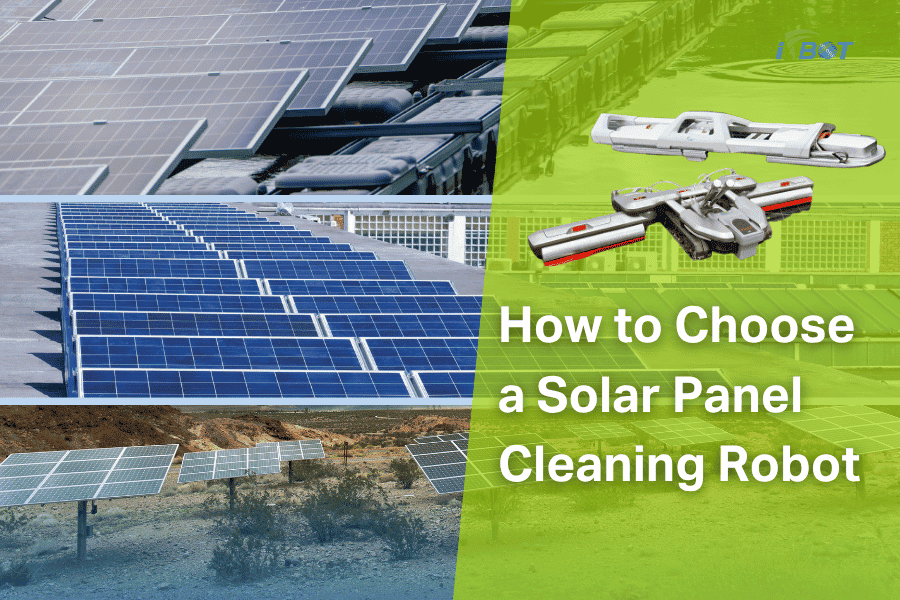
The best solar panel cleaning robot is not necessarily the fastest, most autonomous or most expensive machine. It is the robot that matches your panel layout, tilt angle, contamination, cleaning frequency, available labour and operating environment.
Before comparing suppliers, determine:
Whether your site needs wet or dry cleaning
Whether the robot can operate safely on your panel tilt
How it will handle gaps, edges and separate rows
Its realistic daily coverage on your specific layout
How many people are needed to deploy and operate it
What batteries, brushes, water equipment and replacement parts it requires
Whether technical support is available after purchase
This buyer’s guide explains how to evaluate these factors, compare different types of solar panel cleaning robots and select a system that can work reliably on your installation.
Why the right cleaning robot matters
Soiling is more than a cosmetic issue. Dust, pollution, pollen, salt, bird droppings and biological debris can obstruct sunlight and reduce PV production. The International Energy Agency Photovoltaic Power Systems Programme identifies soiling as one of the leading causes of underperformance in solar installations and estimates that it is responsible for average global energy losses of approximately 4%–7%.
However, cleaning should not be approached as a fixed routine that is identical for every site. Soiling rates, contamination types and cleaning requirements vary considerably between locations. An industrial rooftop near a factory may face a very different problem from a desert solar farm, coastal installation or agricultural PV system.
A suitable robot must therefore solve the actual maintenance problem without creating new operational difficulties.
Start with your solar site - not the robot
A common purchasing mistake is to begin with product specifications.
Operators may compare cleaning speed, brush width or price before determining whether the machine can safely move across their panels. A robot can have excellent specifications but still be unsuitable because of:
Excessive panel tilt
Large gaps between modules
Raised frames
Separate or discontinuous rows
Limited roof access
Insufficient water supply
Contamination that requires a different cleaning method
Structural or handling limitations
Before contacting a manufacturer, collect the following basic site information:
| Site information | Why it matters |
|---|---|
| Total cleanable panel area | Helps estimate cleaning time and robot quantity |
| Panel dimensions | Determines robot and brush compatibility |
| Minimum and maximum tilt | Confirms safe operating range |
| Row length and orientation | Affects productivity and navigation |
| Gaps between modules | Determines whether the robot can cross continuously |
| Frame-height differences | May affect movement and cleaning consistency |
| Roof or ground access | Affects deployment and retrieval |
| Main contamination | Determines whether wet or dry cleaning is more suitable |
| Water availability | Influences cleaning-method selection |
| Frame-height differences | May affect movement and cleaning consistency |
| Required cleaning frequency | Affects batteries, consumables and ROI |
| Time allowed per cycle | Helps calculate the required number of robots |
| Current cleaning cost | Provides a basis for financial comparison |
Photographs, videos and site drawings are often more useful than a simple capacity figure. A 5 MW solar site can consist of one continuous ground-mounted array or dozens of separate rooftop sections, and those two projects may require completely different cleaning solutions.
IFBOT’s solar panel cleaning applications show how installation type, panel configuration and access conditions influence robot selection.
1. Identify the type of solar installation
The first question is where the robot will operate.
Commercial and industrial rooftops
Rooftop installations often have:
Weight restrictions
Narrow access routes
Separate arrays
Walkways, vents and other obstacles
Exposed roof edges
Limited space for lifting equipment
A lightweight portable robot can be easier to carry onto the roof and move between arrays. However, the operator must still confirm that the robot’s dimensions, weight, traction and safety systems are appropriate for the roof and panel structure.
The importance of weight goes beyond convenience. A lighter system may require fewer people for deployment and can be easier to relocate between separate rooftop sections. The article Why Lightweight Solar Cleaning Robots Deliver Real ROI explains how handling, labour and deployment time can affect the overall cleaning cost.
Ground-mounted solar farms
Large, uniform ground-mounted arrays may support:
Portable robots
Remote-controlled machines
Permanently installed rail systems
Fleets of autonomous robots
UAV-assisted deployment
The best option depends on row length, continuity, panel tilt and how quickly the entire site must be cleaned.
A fixed system can make sense for a large, highly uniform plant designed around permanent cleaning infrastructure. A portable robot may be more practical when the system will be used across different sections or several locations.
Solar trackers
Trackers present additional considerations because the panel angle changes throughout the day.
The operator should establish:
At which tracker angle cleaning will occur
Whether the tracker can be placed in a defined cleaning position
Whether the robot has been tested on that configuration
Whether movement, vibration or curvature could affect stability
Whether the robot must cross gaps between tracker tables
Do not assume that a robot suitable for a fixed-tilt array is automatically suitable for a tracker. Ask the supplier to review the tracker model, cleaning position and module arrangement.
Agrivoltaic, fishery-solar and remote installations
Agrivoltaic, fishery-solar, mountain and remote sites can be difficult to access with vehicles or heavy machinery.
In these environments, buyers should examine:
Transport distance
Terrain conditions
Availability of operators
Safe placement and retrieval
Battery charging access
The distance between separate arrays
Where manually transferring robots is the main obstacle, the IFBOT UAV Intelligent PV Cleaning System combines aerial navigation with robot deployment and retrieval. It is intended for projects where conventional movement between arrays is difficult, rather than as a necessary addition to every solar installation.
2. Confirm the panel tilt and operating range
Panel tilt is one of the most important compatibility checks.
Manufacturers should provide a published operating range, but buyers should also ask whether that range applies to:
Wet or dry panels
Framed or frameless modules
Continuous or discontinuous arrays
Normal operation or maximum climbing ability
Specific weather and surface conditions
The IFBOT X3 autonomous dry-cleaning robot has an applicable tilt range of 15°–40°. Its low weight, suction components and autonomous edge detection make it an option for suitable sloped installations where dry cleaning is required.
The IFBOT M20 water-powered cleaning robot has an applicable tilt range of 0°–15° for wet cleaning. It is therefore intended for suitable low-tilt arrays rather than steep rooftop installations.
The operating angle should always be confirmed against the manufacturer’s current technical documentation. Do not select a robot based only on a social media video, distributor claim or maximum climbing figure quoted without its test conditions.
3. Examine gaps, frames and row continuity
A site with long, uninterrupted panel rows is generally easier to automate than a fragmented installation.
Before purchasing, measure or document:
Horizontal and vertical gaps between modules
Gaps between tables
Raised clamps or frame transitions
Differences in panel height
Drainage channels
Expansion joints
Missing modules
Cable trays and roof obstacles
Exposed edges
Ask the supplier which gaps the robot can cross and which require manual transfer.
A robot may clean quickly while it is moving across panels, but frequent stopping, lifting and repositioning can reduce its effective daily capacity. This is why a layout assessment should come before a productivity calculation.
Where arrays are highly fragmented, a lightweight robot may make manual relocation easier. For very large or difficult-to-access layouts, a transport platform, multiple robots or an aerial deployment system may be more appropriate.
4. Match the cleaning method to the contamination
There is no universally superior choice between wet and dry cleaning. The correct method depends on what is on the panels.
When dry cleaning may be suitable
Dry cleaning is generally considered when the main contamination consists of:
Loose dust
Sand
Dry pollen
Light surface particles
Frequently removed contamination
It can also be valuable where:
Water is scarce or expensive
Water transport is difficult
The site wants to avoid hoses and pumps
Panels are cleaned frequently before dirt becomes bonded
The IFBOT X3 combines nano roller brushes with vacuum cleaning. Dirt collected by the brushes is drawn into dust boxes rather than simply being pushed across the panel surface. Its intended application is autonomous dry cleaning rather than removal of contamination that requires washing.
When wet cleaning may be suitable
Water-assisted cleaning may be more appropriate for:
Bird droppings
Mud
Coastal salt deposits
Sticky pollution
Industrial residue
Dirt that has adhered to the glass
Panels that have not been cleaned regularly
The IFBOT M20 uses a water-washing, dual-brush system and is designed for suitable low-tilt installations requiring wet cleaning.
Wet cleaning also introduces additional questions:
Is sufficient water available?
Does the water need filtration or treatment?
How will hoses be managed?
Is a pump or tank required?
Could the water leave mineral residue?
Can cleaning be scheduled when module temperatures are suitable?
The IEA PVPS notes that the cleaning process should be assessed together with the intended module type, contamination, water and cleaning device. It also highlights the need to consider scratching, mechanical forces, water efficiency and robustness in harsh conditions.
For a more detailed comparison, see Dry vs Wet Solar Panel Cleaning Robots.
5. Check robot weight and deployment requirements
A robot’s weight affects more than panel loading. It also influences how many people are needed to:
Carry it to the array
Lift it onto the panels
Move it between rows
Retrieve it at the end of cleaning
Transport it between sites
The IFBOT X3 has 6.2 kg, including the battery. The IFBOT M20 weighs 12.7 kg. Both are designed around portable deployment, although they serve different cleaning applications.
When comparing robots, ask suppliers to demonstrate the full process—not only the cleaning pass.
A practical demonstration should show:
Transport to the array
Placement on the panels
Start-up and control
Movement near edges
Transfer between rows
Battery replacement
Retrieval and storage
A heavier machine may still be suitable for a large uniform ground-mounted site with dedicated lifting equipment. It may be less practical on a rooftop where operators must repeatedly carry it through narrow access points.
6. Compare effective productivity—not maximum speed
Manufacturers often publish productivity in square metres per hour. This is useful, but it should not be treated as guaranteed site output.
Actual productivity can be reduced by:
Setup and retrieval
Row changes
Obstacles
Battery replacement
Water connections
Panel gaps
Repeated passes
Difficult contamination
Safety procedures
Operator experience
The IFBOT M20 has productivity of up to 1,000 m² per hour and a battery runtime of four hours. The IFBOT X3 has productivity of 30 m² per hour and a four-hour battery runtime. They should not be compared on speed alone because they use different cleaning methods and are intended for different site conditions.
A more useful calculation is:
Effective productivity = total area cleaned ÷ total time from deployment to retrieval
For example, a robot may clean at 1,000 m² per hour while moving, but if row changes, hose management and setup occupy a substantial part of the shift, the effective site productivity will be lower.
Ask the supplier to help estimate:
Net cleaning time
Setup time
Row-transfer time
Battery downtime
Number of operators
Expected daily coverage
Number of robots required
The required fleet size should be based on the time available to complete the site, not only its total capacity in megawatts.
7. Decide how much autonomy you need
“Automatic,” “autonomous” and “remote-controlled” do not mean the same thing.
Remote-controlled robots
A remote-controlled machine requires an operator to direct its movement. This can give the operator close control, especially on irregular sites, but it also means labour is required throughout the cleaning cycle.
Semi-automatic robots
A semi-automatic system may maintain speed or direction but still require an operator to manage turns, edges or row transfers.
Autonomous robots
An autonomous robot can use sensors and programmed logic to detect edges, plan movement, stop when necessary or return under specified conditions.
The IFBOT X3 is designed to work autonomously after being placed on a compatible panel array and started. Its product information includes edge detection, route planning, replaceable batteries, low-battery return and night-time operation.
Permanently installed autonomous systems
Fixed systems can clean with minimal routine deployment, but they may require rails, charging stations, communications equipment and project-specific installation.
They can suit large, standardised plants where permanent infrastructure is economically justified. They are usually less flexible for O&M companies that want to move the same cleaning equipment between multiple locations.
UAV-assisted systems
UAV deployment is relevant when the main challenge is moving robots between remote or inaccessible arrays. It adds another layer of automation but also requires consideration of flight planning, local regulations, weather and project complexity.
More autonomy is not automatically better. The correct level depends on the site, available operators, cleaning frequency and budget.
8. Evaluate edge detection and fall protection
Any robot operating on elevated or tilted arrays must have a clearly explained safety strategy.
Ask the manufacturer:
How does the robot detect an exposed edge?
Does it stop automatically?
Does it provide an audible or visual warning?
What happens if a sensor is obstructed?
Is there more than one layer of protection?
Can it recover from uneven alignment?
What operating conditions are excluded?
Is a safety cable or external barrier required?
The M20 has triple-layer fall protection, hazard detection, automatic stopping and warning functions. Its sensors are also designed to detect panel-frame undulations and adjust the robot’s posture.
The X3 uses embedded sensors to detect module edges and determine its cleaning path.
Safety should also extend beyond the machine. IEC 62446-2 covers maintenance recommendations for grid-connected PV systems, including worker safety, reliability and preventive maintenance. Robot operation should therefore be incorporated into the site’s wider O&M and safety procedures rather than treated as an isolated task.
9. Review brush design and panel-surface protection
Not all brush systems operate in the same way.
When evaluating a robot, ask:
What material contacts the module glass?
Is dirt collected or pushed across the surface?
How is brush pressure controlled?
Can the brushes be cleaned during operation?
How frequently must they be replaced?
Has the system been tested with your module type?
Can trapped sand or grit remain in contact with the glass?
The X3 uses opposing nano-fibre roller brushes and vacuum suction to collect loosened particles. The M20 uses a water-assisted dual-brush system for wet cleaning. The article How Robotic Cleaning Mechanisms Work explains the operating differences between the two designs.
The IEA PVPS advises that cleaning equipment should be evaluated together with the expected dust, module type and cleaning process because small particles and mechanical forces can potentially affect the glass or cells.
Do not rely only on a general claim that a robot is safe for panels. Ask for technical information, test conditions and a demonstration using a configuration comparable to your installation.
10. Calculate water, battery and consumable requirements
The robot purchase price is only one part of the operating cost.
Batteries
Check:
Runtime per full charge
Charging time
Number of batteries included
Whether batteries can be replaced during operation
Battery lifespan and replacement cost
Availability in your country
Storage requirements
Both the X3 and M20 list four-hour battery operation, but the number of batteries required will depend on the intended shift length and whether charging can continue while another battery is in use.
Brushes and contact components
Ask how frequently the following may need replacement:
Roller brushes
Bristle brushes
Rubber elements
Suction cups
Filters
Wheels or tracks
Seals
Replacement frequency will vary with cleaning hours, contamination and maintenance. The IFBOT FAQ also distinguishes consumables from components covered by the standard product warranty.
Water equipment
For a wet-cleaning robot, calculate:
Water consumption
Pump requirements
Hose length
Water storage
Filtration or treatment
Drainage
Transport between rows
A robot may be lightweight and easy to place, but poor hose management can still slow the cleaning cycle. Review the entire water-delivery process as part of the site assessment.
11. Compare warranty, training and technical support
A cleaning robot is operational equipment, not a one-time consumer purchase.
Before ordering, confirm:
Warranty duration
What the warranty excludes
Which parts are considered consumables
Where repairs are performed
Expected response time
Availability of remote diagnostics
Local distributor or service support
Operator training
Spare-parts lead times
Technical documentation language
Ask suppliers to include support, training, batteries, chargers, accessories, freight and taxes clearly in the quotation. Two robots with similar purchase prices may have very different lifetime costs when parts availability and service are considered.
12. Calculate the total cost of ownership
The cheapest robot is not always the most economical.
A total-cost comparison should include:
Initial costs
Robot
Batteries and chargers
Brushes and spare parts
Water equipment
Transport accessories
Shipping and import costs
Training and commissioning
Site modifications
Recurring costs
Operator labour
Water and electricity
Consumables
Battery replacement
Preventive maintenance
Repairs
Storage and transport
Technical support
Potential savings
Reduced manual labour
Fewer contractor visits
Faster cleaning cycles
Lower water use where dry cleaning is appropriate
Reduced equipment rental
More frequent cleaning using the same team
Better utilisation across multiple sites
The comparison should be based on the complete cost per cleaning cycle, not the robot invoice alone. IFBOT’s comparison of robotic and manual solar panel cleaning discusses how cleaning method, labour, frequency and water availability influence O&M economics.
Solar panel cleaning robot comparison
| Cleaning solution | Best suited to | Main advantages | Important limitations |
|---|---|---|---|
| Portable autonomous dry-cleaning robot | Dust-heavy sites, water-restricted areas and compatible sloped arrays | Low water demand, portable deployment and reduced continuous operator control | May not remove mud, salt deposits or strongly bonded contamination |
| Portable water-powered robot | Low-tilt arrays with sticky or persistent contamination | Wet cleaning, wide brush coverage and fast cleaning on suitable layouts | Requires water and hose management; not intended for panel angles outside its published range |
| Heavy remote-controlled robot | Large, uniform sites with lifting and transport support | High cleaning capacity and direct operator control | More difficult to carry and reposition; may require additional labour or machinery |
| Fixed rail-mounted robot | Large, standardised utility-scale plants | Regular unattended cleaning and limited daily deployment | Permanent infrastructure, installation cost and reduced flexibility |
| UAV-assisted robot deployment | Remote, fragmented or difficult-to-access arrays | Reduces manual transfers and supports multi-array deployment | Greater project complexity and possible weather or regulatory constraints |
| Manual cleaning | Small or infrequently cleaned installations | Low initial equipment cost and flexible human judgement | Labour-intensive, difficult to scale and potentially inconsistent |
Which IFBOT robot is suitable for which site?
| Requirement | IFBOT X3 | IFBOT M20 | IFBOT UAV system |
|---|---|---|---|
| Cleaning method | Dry brush and vacuum | Water-assisted dual brush | Aerial robot deployment and retrieval |
| Published weight | 6.2 kg | 12.7 kg | Project-system configuration |
| Published panel tilt | 15°–40° | 0°–15°, wet cleaning only | Depends on the cleaning robot and project |
| Published productivity | 30 m²/h | Up to 1,000 m²/h | Site-specific |
| Battery runtime | Four hours | Four hours | Project-specific |
| Best suited to | Loose dust, water-restricted sites and suitable sloped arrays | Persistent contamination on compatible low-tilt arrays | Large, remote or fragmented installations |
| Less suitable when | Dirt requires washing or the array is outside the published operating range | Water is unavailable or panels exceed the published tilt range | A small, easily accessible site does not justify aerial deployment |
Choose the IFBOT X3 when:
The dominant contamination is loose dust or sand
Water use is undesirable
Panels fall within the confirmed operating range
Lightweight handling is important
Autonomous cleaning is preferred
The layout is compatible with its navigation and edge-detection system
The X3 should not be selected when the primary problem is mud, bird droppings, bonded salt or other contamination that requires water-assisted cleaning.
Choose the IFBOT M20 when:
The site has suitable low-tilt panels
Wet cleaning is available and appropriate
Contamination is difficult to remove through dry brushing
The operator needs high cleaning capacity
Lightweight deployment is important
Water and hose management can be organised efficiently
The M20 should not be positioned as the solution for steep arrays outside its published 0°–15° wet-cleaning range.
Consider the IFBOT UAV system when:
Arrays are difficult to reach from the ground
Robots must be transferred over long distances
Terrain makes vehicle movement difficult
The site contains many separated PV sections
The project needs a more automated deployment method
For a simple, easily accessible rooftop, manually positioning a lightweight robot may be more practical than introducing an aerial system.
A broader side-by-side overview is available in the IFBOT solar cleaning robot comparison.
Questions to ask every solar panel cleaning robot supplier
Before requesting a final quotation, ask:
Is the robot compatible with my exact panel tilt?
Can it work with my module dimensions and frame design?
What gaps and height differences can it cross?
Is it intended for my type of contamination?
What is the effective daily productivity on a site like mine?
How many operators are required?
How is the robot placed, moved and retrieved?
What happens when it reaches an edge or obstacle?
Which batteries, chargers and accessories are included?
Which components require regular replacement?
What training, warranty and technical support are provided?
What is the complete delivered and operational cost?
A credible supplier should request information about your installation before recommending a robot.
Be cautious when a supplier:
Claims that one robot suits every panel layout
Recommends a model without reviewing the tilt
Quotes maximum speed as guaranteed daily output
Cannot explain edge protection
Provides no information about replacement parts
Avoids discussing the limitations of the product
Offers a price without clarifying what is included
IFBOT also discusses practical limitations in What Are the Disadvantages of Solar Panel Cleaning Robots?, which can help buyers evaluate where automation may require additional planning.
Information to include in your quotation request
To receive a useful recommendation, provide:
Country and site location
Delivery destination
Installed PV capacity
Approximate cleanable panel area
Module make and dimensions
Panel tilt range
Photographs or drawings of the array
Details of gaps and frame transitions
Current cleaning method
Main contamination
Cleaning frequency
Water availability
Required completion time
Number of operators available
Preferred wet or dry cleaning
Number of sites where the robot may be used
The more complete the site information, the more accurately the supplier can assess suitability, estimate the required robot quantity and calculate the delivered cost.
Frequently asked questions
What is the best solar panel cleaning robot?
There is no single best robot for every installation. The correct choice depends on panel tilt, layout, contamination, water availability, cleaning frequency, access and required productivity.
A dry autonomous robot may be the best option for loose dust and water-restricted conditions. A water-powered robot may be more suitable for persistent contamination on low-tilt panels. Fixed or UAV-assisted systems may be considered for large or difficult-to-access projects.
Should I choose wet or dry robotic cleaning?
Choose according to the contamination and site conditions.
Dry cleaning may suit loose dust and frequent maintenance. Wet cleaning may be necessary for mud, salt, bird droppings and sticky industrial residue. The decision should also account for water availability, mineral content, hose handling and cleaning frequency.
Can solar panel cleaning robots work on tilted panels?
Some can, but every robot has a defined operating range.
The IFBOT X3 has an applicable tilt range of 15°–40°. The M20 has 0°–15° for wet cleaning. The actual project should be reviewed before purchase, particularly where panels are close to the limit or have gaps and uneven transitions.
How many robots does a solar farm need?
The number depends on:
Total cleanable area
Effective productivity
Time available per cleaning cycle
Daily working hours
Battery strategy
Row-transfer time
Cleaning frequency
Calculate fleet size using realistic site productivity rather than the maximum hourly specification.
Is a lightweight robot always better?
A lightweight robot can be easier to carry, place and transfer, especially on rooftops and fragmented arrays. However, weight is only one factor. The machine must also have suitable traction, cleaning performance, safety systems and durability.
Do solar cleaning robots remove bird droppings?
Water-assisted brushing is generally more appropriate for strongly bonded contamination such as dried bird droppings. A dry-cleaning robot intended for loose particles may not be the correct solution.
The supplier should review photographs or test the contamination before recommending a product.
Can one cleaning robot be used at several sites?
Portable robots can often be transported between installations, making them relevant to O&M contractors and owners managing several sites. Transport, storage, batteries, training and compatibility must still be considered for each location.
How much does a solar panel cleaning robot cost?
Price depends on the type of robot, quantity, accessories, batteries, water equipment, shipping, support and site requirements. Compare the complete delivered cost and cost per cleaning cycle rather than only the base machine price.
Choose a robot based on evidence, not specifications alone
A solar panel cleaning robot should be selected as part of the site’s complete O&M plan.
The decision should account for:
What is contaminating the panels
How the array is constructed
Whether water is available
How the robot reaches and leaves the panels
How much area it can clean in a real shift
What happens at edges, gaps and obstacles
How the equipment will be maintained
Whether the investment reduces the site’s total cleaning cost
The final step should be a compatibility assessment using panel drawings, photographs, tilt data and operating requirements.
Request an IFBOT site assessment and quotation. Send the team your panel layout, cleanable area, tilt angle, location and main contamination, and IFBOT will recommend the most suitable cleaning solution for your project.