
Water Scarcity and Solar Panel Cleaning Robots
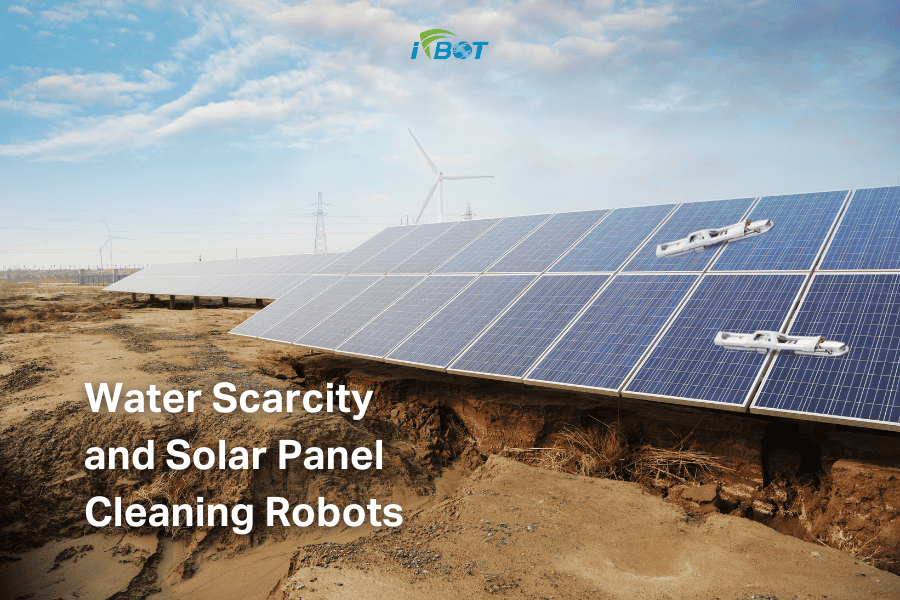
Water Scarcity and Solar Cleaning: Why Water-Free Robots Make Sense in MENA & Australia
Water scarcity is a defining constraint in the Middle East, North Africa (MENA), and Australia. Traditional solar panel cleaning methods rely heavily on water - sometimes thousands of liters per megawatt per cycle - creating operational, financial, and environmental pressure.
Water-free robotic solar cleaning systems offer a scalable alternative. They reduce water dependency, minimize mineral residue risks, lower OPEX, and support ESG goals. In arid and semi-arid climates, dry cleaning automation is not just an option - it is becoming a strategic necessity.
This article explains:
Why water-based cleaning is increasingly unsustainable
The technical risks of using water in dusty, high-mineral regions
How dry robotic cleaning works
ROI implications for utility-scale plants
Why MENA and Australia are leading the shift
The Real Challenge: Solar Growth in Water-Stressed Regions
MENA and Australia share two defining characteristics:
Abundant solar irradiation
Chronic water scarcity
Countries such as Saudi Arabia, United Arab Emirates, and Australia are investing heavily in solar infrastructure to diversify energy sources and reduce carbon intensity.
But here’s the paradox:
Solar plants are often built in desert or semi-arid environments — precisely where:
Dust accumulation is highest
Water resources are most limited
Logistics for water delivery are expensive
In these regions, cleaning becomes both critical and complicated.
Why Do Solar Panels Need Frequent Cleaning in MENA & Australia?
In arid environments, solar modules face:
Fine desert dust (PM10 and smaller)
Sandstorms
Pollen and organic residues
Bird droppings
Industrial airborne particles
Studies across desert solar farms show soiling losses can reach 15–35% if cleaning cycles are delayed.
When developers ask:
“Can we just clean less frequently to save water?”
The answer is usually no — because reduced cleaning equals reduced generation revenue.
The Hidden Problem With Water-Based Cleaning
At first glance, water cleaning seems logical. But in water-stressed regions, it introduces three major risks.
1️⃣ Water Availability & Cost
Utility-scale solar plants may require:
3,000–10,000 liters of water per MW per cleaning cycle
Multiple cleanings per month in dusty seasons
Water must often be:
Trucked in
Desalinated
Treated
This significantly increases operational expenditure (OPEX).
2️⃣ Mineral Residue & Scaling
Water in desert regions often contains:
High TDS (Total Dissolved Solids)
Calcium and magnesium salts
Silica
If not perfectly treated, water cleaning can leave mineral deposits that:
Create light scattering
Cause micro-abrasion over time
Reduce module efficiency
Ironically, poorly managed water cleaning can increase long-term losses.
3️⃣ ESG & Sustainability Contradiction
Solar power represents sustainability.
But consuming large volumes of freshwater in arid regions contradicts environmental goals.
Investors and regulators increasingly ask:
“Is the cleaning process aligned with our sustainability commitments?”
Water-heavy cleaning systems raise difficult ESG questions.
Why Water-Free Solar Cleaning Robots Make Sense
Dry robotic cleaning systems are designed specifically for high-dust, low-water environments.
At IFBOT, our dry-cleaning platform — including the IFBOT X3 — is engineered to operate without water while maintaining high cleaning effectiveness.
Let’s break down how it works and why it’s relevant for MENA and Australia.

How Water-Free Cleaning Technology Works
Modern dry cleaning robots combine:
Anti-static microfiber or engineered brush systems
Controlled pressure distribution
Low-speed, high-contact surface cleaning
Smart navigation systems
Lightweight chassis to avoid panel stress
The goal is simple:
Remove dust mechanically without scratching glass or requiring water.
When implemented correctly, dry cleaning:
Maintains panel surface integrity
Eliminates mineral residue risks
Reduces water logistics
Enables more frequent cleaning cycles
Performance Comparison: Water vs Water-Free
| Factor | Water-Based Cleaning | Water-Free Robotic Cleaning |
|---|---|---|
| Water consumption | High | Zero |
| Mineral residue risk | Medium to high | None |
| Operational logistics | Complex | Minimal |
| Cleaning frequency | Limited by water supply | Flexible |
| ESG alignment | Questionable in arid zones | Strong |
In MENA and Australia, the equation is increasingly clear.
ROI Impact: What Developers Actually Care About
Ultimately, plant owners ask:
“Does dry cleaning improve financial performance?”
In most desert installations:
Soiling rates are high
Cleaning frequency must increase
Water logistics inflate costs
Water-free automation enables:
Regular daily or weekly cleaning
Stable generation curves
Reduced manpower
Lower long-term OPEX
Over multi-year plant operation, the financial difference becomes substantial.
Addressing Common Concerns
“Does dry cleaning scratch panels?”
When improperly designed — yes.
When engineered with correct brush materials, pressure calibration, and chassis stability — no.
High-quality robotic systems distribute weight carefully and use tested materials compatible with tempered solar glass.
“Is water-free cleaning effective against sticky dirt?”
In desert regions, most soiling is dry dust, which responds well to mechanical cleaning.
In coastal or industrial zones where salt mist or sticky residues occur, hybrid strategies may be evaluated. But in large desert solar fields, dry cleaning is often sufficient.
“Is automation reliable in extreme heat?”
MENA and Australian plants operate under high temperatures and UV exposure.
Robotic systems must be:
Heat-resistant
Dust-sealed
Designed for large-scale deployment
Engineering quality determines durability.
Why MENA & Australia Are Leading the Shift
Solar capacity growth is accelerating in:
United Arab Emirates
Saudi Arabia
Australia
These regions are now setting global benchmarks in:
Utility-scale solar innovation
Desert deployment strategies
Sustainable O&M practices
Water-free cleaning aligns with:
Government sustainability targets
Water conservation policies
Long-term infrastructure resilience
Strategic Outlook: Cleaning as an Energy Optimization Lever
Solar developers once saw cleaning as maintenance.
Today, it is recognized as:
A performance optimization tool
A risk management factor
An ESG alignment decision
A cost-control strategy
As energy markets mature, small efficiency differences compound over years.
Water-free robotic cleaning is no longer a niche technology — it is becoming infrastructure standard in water-stressed regions.
Conclusion: When Water Is Scarce, Innovation Must Adapt
In water-abundant regions, traditional cleaning may remain viable.
But in MENA and Australia, the logic is changing.
When:
Water is expensive
Dust is frequent
ESG standards are rising
Solar investments are long-term
Water-free robotic solar cleaning simply makes strategic sense.
FAQ
What is water-free solar panel cleaning?
Water-free solar panel cleaning uses robotic systems with engineered brushes or microfiber mechanisms to remove dust without using water.
Why is water-based cleaning problematic in MENA?
MENA regions face water scarcity, high mineral content in water, and expensive water logistics, making traditional cleaning costly and less sustainable.
Does dry cleaning reduce solar efficiency?
No. When engineered properly, dry cleaning maintains or improves energy yield by allowing more frequent maintenance cycles.
Is water-free cleaning safe for panels?
Yes, when robots are designed with controlled pressure systems and compatible brush materials.
Which regions benefit most from dry solar cleaning?
Desert and semi-arid regions such as the Middle East, North Africa, and Australia benefit most due to high dust and limited water supply.
Ready to Rethink Solar Cleaning in Water-Scarce Regions?
If your solar project operates in MENA or Australia, water is no longer just a utility — it’s a strategic constraint.
The question isn’t whether you should optimize cleaning.
It’s whether your current approach aligns with long-term performance, sustainability goals, and cost efficiency.
At IFBOT, we engineer water-free robotic solar cleaning systems built specifically for high-dust, high-temperature, water-limited environments.
Let’s evaluate your site conditions, soiling rates, and O&M strategy — and determine whether a dry, automated solution can increase yield while reducing water dependency.
👉 Visit the contact or request a quote page to discuss a site-specific assessment and explore a smarter, water-free cleaning strategy.