
How Much Energy Do Dirty Solar Panels Lose?
Direct answer: how much energy do dirty solar panels lose?
Dirty solar panels commonly lose around 3% to 7% of annual energy output from soiling, depending on location, weather, dust level, panel angle, rainfall, pollution, bird droppings, and cleaning frequency.
In high-dust environments, the loss can be much higher.
For solar operators, the important point is simple:
Every 1% of soiling loss is energy that was already paid for, installed, and ready to generate — but never reached the inverter.
That is why solar panel cleaning is not only a visual maintenance task. It is a direct performance and revenue protection activity.
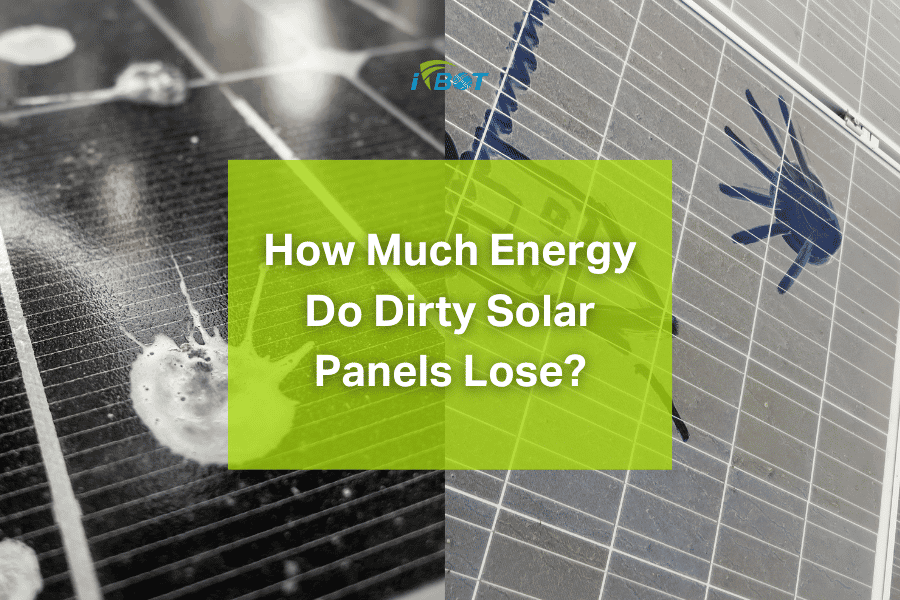
A panel does not need to look completely covered in dust to lose output. A thin layer of dirt can reduce the amount of sunlight reaching the cells. Uneven dirt, bird droppings, industrial residue, pollen, sand, cement dust, and mud marks can also create inconsistent production across modules.
For large commercial rooftops and PV plants, these small losses become serious because they happen across thousands of panels at the same time.
Why dirty solar panels lose energy
Solar panels generate electricity by converting sunlight into power. When dirt sits on the glass surface, it blocks, scatters, or absorbs part of that sunlight before it reaches the solar cells.
The result is lower energy output.
The loss depends on several factors:
Dust density: More dust usually means more blocked sunlight.
Type of dirt: Fine dust, cement particles, bird droppings, oily residue, salt, and pollen behave differently.
Panel angle: Lower-tilt panels often hold dirt for longer because gravity and rainwater remove less buildup.
Rainfall pattern: Light rain can sometimes make panels worse by turning dust into a sticky layer.
Local environment: Farms, deserts, industrial areas, coastal sites, construction zones, and roadsides usually face higher soiling risk.
Cleaning frequency: The longer panels stay dirty, the more energy is lost between cleaning cycles.
This is why there is no single global number that fits every solar site. A clean rooftop in a rainy climate and a commercial rooftop near an industrial zone will not have the same soiling pattern.
The better question is not only:
“How dirty are the panels?”
It is:
“How much energy and revenue are we losing before the next cleaning cycle?”
The real impact: what dirty panels cost in lost revenue
Soiling loss becomes clearer when it is converted into money.
Here is a simple way to estimate the impact:
Annual lost revenue = Annual energy generation × Soiling loss % × Electricity value
For example, a 10 MW solar site operating at an 18% capacity factor produces approximately:
10 MW × 8,760 hours × 18% = 15,768 MWh per year
If dirty panels reduce output by 5%, the site loses:
788 MWh per year
If electricity is valued at USD 80 per MWh, the revenue loss is:
USD 63,040 per year
And that is only one example.
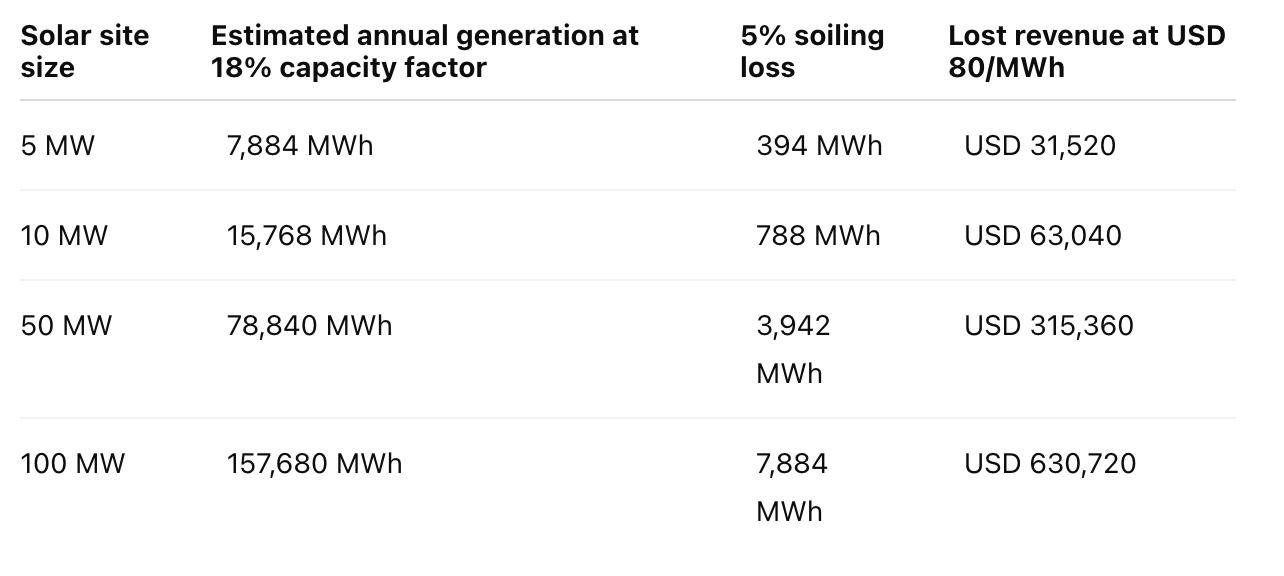
The exact number will change depending on the power price, PPA structure, tariff, capacity factor, climate, and cleaning cost.
But the business logic is clear:
For commercial and utility-scale solar sites, dirty panels can turn into a large hidden cost.
The loss is not always visible in one day. It builds gradually through lower daily generation, lower performance ratio, and delayed recovery after soiling events.
When does solar panel cleaning become critical?
Cleaning becomes critical when the cost of lost energy becomes higher than the cost of cleaning.
This usually happens faster in sites where soiling accumulates quickly or where energy value is high.
Solar operators should pay close attention to cleaning when any of the following conditions apply.
1. Output drops below expected performance
If the site’s performance ratio or yield is falling while irradiance and equipment conditions remain normal, soiling should be checked.
A small performance drop may not look urgent at first. But across a large solar site, even a 3% to 5% loss can represent a meaningful amount of lost generation.
2. The site is in a dusty or polluted environment
Cleaning becomes more important for solar panels located near:
industrial facilities
cement plants
construction areas
agricultural land
highways or unpaved roads
desert or semi-desert regions
coastal areas with salt deposits
high-pollen environments
In these environments, waiting for rain is often not enough.
3. Panels have low tilt angles
Low-tilt solar panels are common on commercial rooftops and many large installations. They are also more likely to hold dust, water marks, mud residue, and lower-edge dirt buildup.
When panels do not shed dirt naturally, regular cleaning becomes more important.
This is one reason why portable solar panel cleaning robots are becoming more relevant for commercial rooftop PV systems and low-tilt solar arrays.
4. Rain has not cleaned the panels properly
Rain does not always solve soiling.
Heavy rain can help remove loose dust. But light rain can create streaks, mud spots, or sticky residue. In some locations, rain may move dirt from the upper panel area to the lower edge, where it accumulates and continues affecting output.
A site can look “washed” after rain but still perform below its clean-panel potential.
5. The site is entering peak production season
Solar cleaning is especially important before high-irradiance periods.
If panels are dirty during the strongest production months, the site loses energy when it has the highest generation potential.
For many operators, a proactive cleaning schedule before peak season can be more effective than waiting until losses become obvious.
6. Manual cleaning is too slow or inconsistent
Manual cleaning works, especially for small systems.
But at commercial and large-scale sites, manual cleaning can become difficult to repeat consistently. Different crews, long rows, rooftop access limits, safety concerns, water handling, and time pressure can all affect cleaning quality.
When cleaning is delayed or uneven, energy loss continues.
That is where robotic solar panel cleaning becomes more useful.
How regular maintenance improves solar panel efficiency
Cleaning does not change the original efficiency rating of the solar panel.
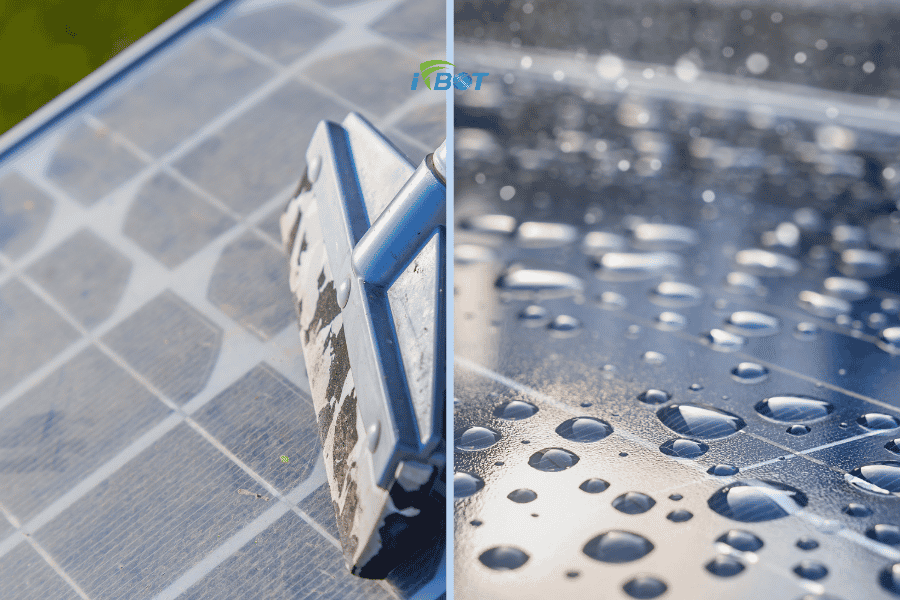
Instead, it helps the panel operate closer to its expected performance by removing the layer of dirt that blocks sunlight.
Regular solar panel maintenance can improve real-world output by:
restoring access to sunlight
reducing avoidable soiling losses
keeping production more stable across the site
helping operators detect abnormal performance issues sooner
improving cleaning consistency across multiple panel rows
reducing dependence on reactive cleaning after output drops
For O&M teams, the goal is not to clean as often as possible.
The goal is to clean at the right time, with the right method, at the right cost.
The solution: IFBOT M20 for consistent wet cleaning
For sites where dust, sticky grime, industrial residue, mud marks, or lower-edge buildup affect performance, the IFBOT M20 provides a practical way to make solar panel cleaning more consistent and scalable.
The M20 is a lightweight, water-powered solar panel cleaning robot designed for faster wet cleaning with less manual effort.
It is especially relevant for commercial rooftops, low-tilt installations, and solar sites where operators need repeatable cleaning quality without relying only on large manual cleaning teams.
Why M20 helps protect energy output
1. It makes cleaning more repeatable
Dirty panels often become a problem because cleaning is delayed, inconsistent, or difficult to scale.
The M20 helps operators move from reactive cleaning to a more repeatable maintenance process. With cruise control mode and a dual-brush wet-cleaning system, teams can clean panel rows more consistently and reduce variation from one cleaning round to another.
2. It reduces manual labour pressure
Manual cleaning becomes harder to manage as site size increases.
The M20 weighs only 12.7 kg, making it easier for one operator to carry, position, and deploy. This helps reduce the physical burden of routine solar cleaning, especially on commercial rooftops or sites where panels are spread across multiple areas.
3. It supports faster daily cleaning operations
The M20 offers productivity of up to 1000 m²/h, helping solar teams cover more panel area in less time compared with fully manual methods.
For operators, speed matters because every delay between “panels are dirty” and “panels are cleaned” can mean more lost generation.
4. It is designed for wet cleaning when water is needed
Not all soiling can be removed effectively with dry methods.
Sticky dust, mud marks, bird droppings, industrial residue, and lower-edge dirt often require water-assisted cleaning. The M20 uses a water-washing dual-brush system to support stronger dirt removal where wet cleaning is the right method.
5. It improves safety around edges and operating areas
Cleaning solar panels often involves working near edges, rows, slopes, and access-limited areas.
The M20 includes triple-layer fall protection, with hazard detection, automatic stopping, warning lights, and voice alerts. This helps support safer operation during routine cleaning.
6. It is built for low-tilt wet-cleaning applications
The M20 is designed for wet cleaning on solar panels with applicable tilt angles from 0° to 15°.
This makes it suitable for many commercial rooftop systems and low-tilt solar installations where dirt accumulation is a common maintenance challenge.
For high-tilt or sun-tracking solar systems, the cleaning method should always be assessed based on the panel angle, tracker position, row design, surface condition, access route, and site safety requirements. In many cases, cleaning strategy may require a combination of robotic, manual, dry, wet, or drone-supported deployment depending on the site.

When M20 becomes a strong fit
The IFBOT M20 is especially useful when a solar site has:
visible dust or dirt buildup
sticky contamination that needs wet cleaning
low-tilt panels
commercial rooftop access constraints
repeated cleaning requirements
limited cleaning crew availability
pressure to reduce manual labour dependency
need for more consistent cleaning quality
output loss linked to soiling
large panel areas that need faster cleaning cycles
M20 is not just a cleaning tool. It is part of a more reliable O&M process.
Manual cleaning vs M20 robotic cleaning
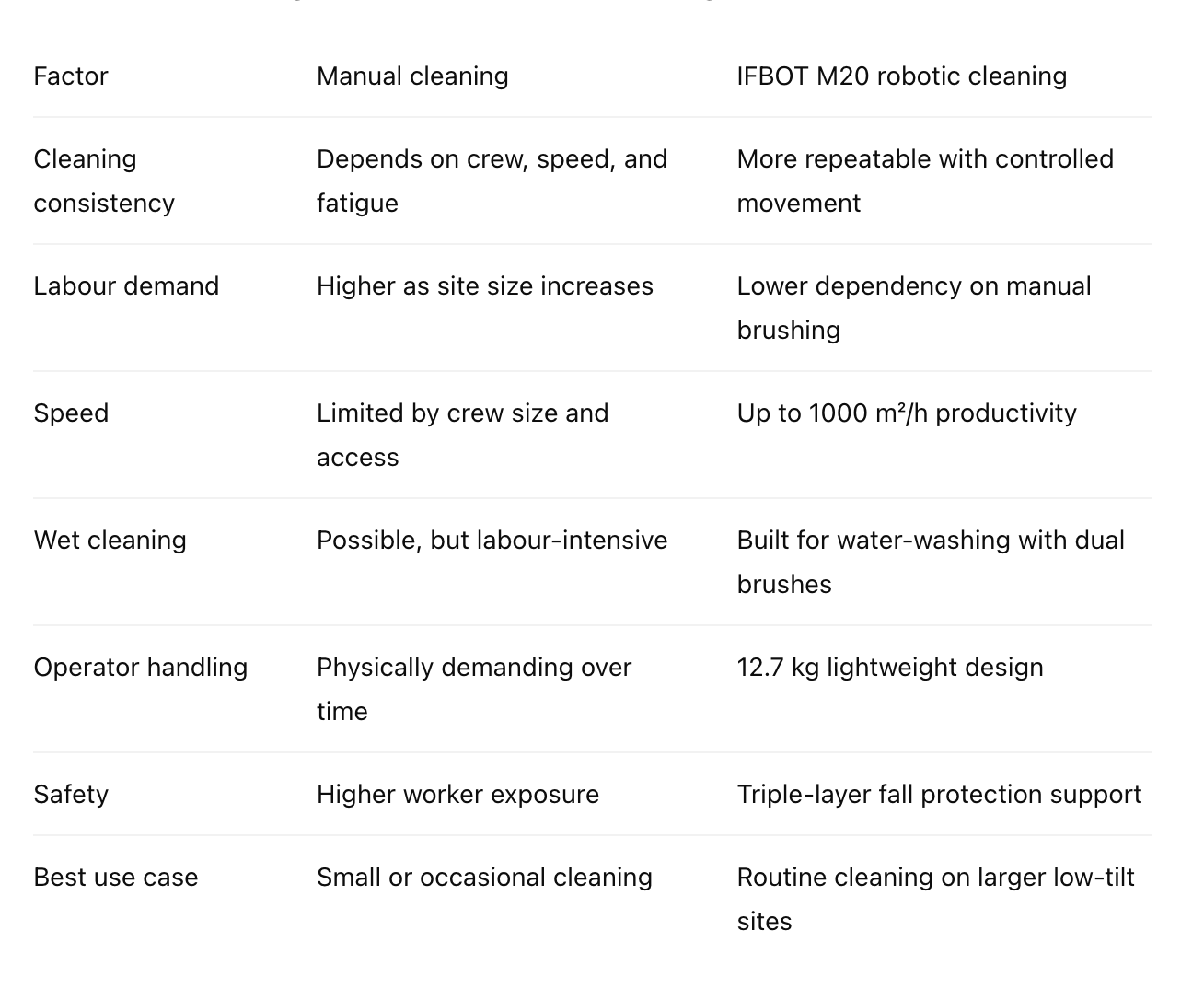
Manual cleaning can still be useful for spot treatment, unusual contamination, or small systems.
But for repeated commercial maintenance, robotic cleaning helps make cleaning more predictable, especially when soiling is directly affecting energy output.
How to decide when to clean
A practical solar cleaning schedule should combine visual checks, performance data, local weather, and economic calculation.
A good starting point is to monitor:
performance ratio trends
generation compared with expected irradiance
visible dirt level
recent dust storms or construction activity
rainfall quality and frequency
seasonal pollen or agricultural activity
bird droppings or local wildlife impact
panel tilt and lower-edge buildup
cleaning cost versus estimated energy loss
The best cleaning strategy is not fixed. It should adapt to site conditions.
For example, a commercial rooftop near an industrial area may need more regular wet cleaning than a rooftop in a rainy, low-dust location. A large solar farm in a dusty region may need a different cleaning model again.
The real answer: dirty panels lose energy every day until they are cleaned
Dirty solar panels do not always create sudden failure.
They create quiet underperformance.
The system continues operating, but it produces less than it should. For a small installation, that loss may be manageable. For commercial and utility-scale solar, the loss can quickly become a financial issue.
That is why regular solar panel maintenance matters.
Cleaning should not be treated as an occasional reaction when panels look visibly dirty. It should be part of a planned O&M strategy that protects energy yield, reduces avoidable losses, and keeps the solar asset performing closer to its expected output.
For many low-tilt commercial and large PV sites, IFBOT M20 helps make that strategy easier to execute.
Talk to IFBOT about your solar cleaning challenge
Every solar site has a different soiling profile.
Tell us your site size, panel angle, location, cleaning frequency, and contamination type. The IFBOT team can help you evaluate whether M20 is the right wet-cleaning solution for your project.
Protect solar output before dirt turns into lost revenue.
FAQs
How much energy do dirty solar panels lose?
Dirty solar panels commonly lose around 3% to 7% of annual energy output from soiling, depending on site conditions. In dusty or polluted environments, losses can be much higher.
Can dirty solar panels lose efficiency even if they do not look very dirty?
Yes. A thin layer of dust can reduce the amount of sunlight reaching the cells. Panels do not need to look heavily covered to lose output.
Does rain clean solar panels enough?
Sometimes, but not always. Heavy rain can remove loose dust, but light rain may leave streaks, mud marks, or lower-edge dirt buildup. Sites in dusty, industrial, coastal, or agricultural areas often need planned cleaning.
When should commercial solar panels be cleaned?
Commercial solar panels should be cleaned when soiling losses become higher than cleaning cost, when performance data shows unexplained output decline, before peak production periods, or after visible contamination such as dust storms, bird droppings, construction dust, or industrial residue.
How does cleaning improve solar panel efficiency?
Cleaning removes dirt that blocks sunlight from reaching the solar cells. It does not change the panel’s rated efficiency, but it helps restore real-world energy output closer to expected performance.
Is robotic solar panel cleaning better than manual cleaning?
Robotic cleaning is often better for larger or repeated cleaning operations because it improves consistency, reduces labour dependency, and helps teams clean more predictably. Manual cleaning may still be suitable for small systems or special spot cleaning.
What type of solar panels can IFBOT M20 clean?
IFBOT M20 is designed for wet cleaning on solar panels with applicable tilt angles from 0° to 15°. It is suitable for many commercial rooftop and low-tilt PV installations where wet cleaning is needed.
Can M20 clean high-tilt or sun-tracking solar panels?
M20 should be used within its applicable wet-cleaning tilt range of 0° to 15°. For high-tilt or sun-tracking systems, IFBOT recommends evaluating the site layout, tracker position, access conditions, and safety requirements before choosing the right cleaning method.
What is the main benefit of IFBOT M20?
The main benefit of IFBOT M20 is more consistent, scalable wet cleaning with less manual labour pressure. It helps solar operators protect output by making routine panel cleaning easier to perform at the right time.
Why is solar panel cleaning important for O&M?
Solar panel cleaning is important because soiling affects energy yield, revenue, and performance predictability. Regular cleaning helps reduce avoidable energy loss and supports a more reliable solar O&M strategy.